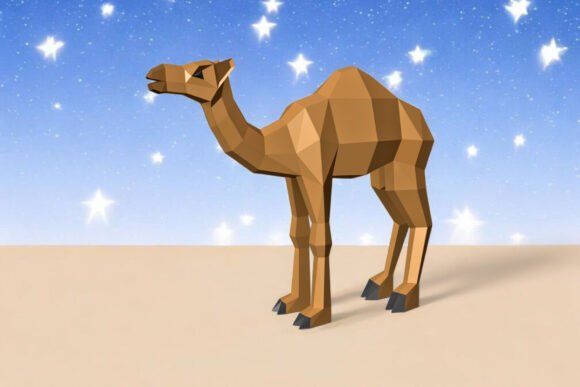
Camel - 3d Papercraft: A Designer’s Review of This 3D SVG Shapes Asset
I recently received a brief from a client launching a boutique artisanal brand specializing in natural, earth-toned home goods. They wanted their packaging and social media presence to feel tactile, warm, and distinctly handmade, yet polished enough for retail shelves. During the concept phase, I needed a visual anchor that could communicate texture and dimension without relying on heavy photography. That is when I evaluated Camel - 3d Papercraft, a digital asset categorized under Shapes and formatted as a versatile 3D SVG. What follows is my professional assessment of whether this asset holds up in real-world commercial design scenarios.
First Impressions and Visual Mood
When you first open the files for Camel - 3d Papercraft, the immediate takeaway is its structural integrity. Unlike flat clipart or generic illustrations, this asset leverages the geometry of papercraft to create depth. The style is inherently playful but grounded in a clean, geometric aesthetic. It evokes a sense of nostalgia mixed with modern minimalism—a look that resonates strongly with current trends in brand identity for small businesses and creative marketplaces.
The color palette suggested by the default preview leans into warm neutrals, which aligns perfectly with the "earthy" vibe my client requested. However, because it is delivered as a digital product containing multiple formats (PDF, DXF, EPS, PNG, JPG), the true value lies in its adaptability. As a designer, I appreciate assets that do not dictate a single rigid interpretation but rather serve as a flexible foundation for creative design.
Performance in Real Design Situations
In my workflow, I test every new asset across various mediums before recommending it to a client. Here is how Camel - 3d Papercraft performed during my simulation:
- Packaging Design: This was the strongest use case. The assembled size of 10 x 9 x 25 CMS provides a substantial footprint for labels or box inserts. When used as a decorative element on kraft paper packaging, the papercraft style mimics actual die-cut details, adding perceived value to the product.
- Social Media Graphics: For Instagram posts and Pinterest pins, the 3D effect creates a focal point that stands out in crowded feeds. It works exceptionally well as a hero graphic for announcements or product launches.
- Print-on-Demand & Merchandise: I tested the vector layers for potential use on tote bags and mugs. The clean lines of the SVG design translate well to sublimation printing, provided the background contrast is managed correctly. It serves as an excellent base for sticker design collections.
- Editorial Design: In blog visuals or digital magazines, this asset breaks up text-heavy layouts effectively. It adds a touch of whimsy without overwhelming the editorial hierarchy.
Strategic Placement and Best Practices
To get the most out of this asset, strategic placement is key. Camel - 3d Papercraft excels in large layout areas where its dimensional qualities can be appreciated. It is ideal for product mockups, acting as a prop within a scene, or as a standalone marketing visual for seasonal campaigns.
However, there are limitations. You must use this asset carefully in small sizes. At thumbnail dimensions, the intricate folds and shadows of the 3D SVG may blur, losing the intended effect. Similarly, avoid placing it in crowded layouts or against complex backgrounds. If your project requires strict visual hierarchy and minimalist branding, this asset might compete too aggressively with typography. It is less suitable for corporate materials where a sterile, clean look is required. Instead, reserve it for projects that embrace warmth, such as handmade business branding, craft fairs, or lifestyle-oriented startups.
Impact on Readability and Brand Trust
Using Camel - 3d Papercraft influences the emotional appeal of a design significantly. It signals approachability and creativity. When integrated into a cohesive system, it enhances audience engagement by inviting the viewer to imagine the tactile experience of the object. However, designers must ensure it does not compromise readability. Pairing this graphic with a sturdy sans serif font or a clean display font maintains balance. Avoid pairing it with overly ornate script fonts, as the combination can become visually noisy. The goal is to support the message, not distract from it.
Practical Designer Notes for Commercial Use
Before integrating Camel - 3d Papercraft into a final deliverable, I recommend running through this checklist:
- Format Inspection: Verify the vector editability in the EPS or SVG file. Ensure all paths are closed and layers are organized. This is crucial if you need to recolor the asset for a specific brand palette.
- Transparency Check: If using the PNG design, inspect the edges for anti-aliasing artifacts, especially when placing it over dark or patterned backgrounds.
- Contrast Testing: Preview the asset in black and white to ensure the form holds up without color reliance. Test it on both light and dark backgrounds to confirm legibility.
- Mockup Integration: Place the asset in a realistic context. Does it look like a sticker? A cutout? A printed card? Adjusting drop shadows and blending modes can help it sit naturally within the composition.
- Licensing Confirmation: Always review the commercial license. While many of these assets allow for end-product sales, restrictions often apply to reselling the raw digital files themselves.
Final Verdict
Camel - 3d Papercraft is more than just a collection of shapes; it is a tool for storytelling. With an assembling time of approximately 30 minutes, it offers a unique interactive element that can be highlighted in video content or behind-the-scenes marketing. For designers working on Etsy products, printable designs, or web design projects that require a touch of organic charm, this asset is a valuable addition to the library.
It bridges the gap between digital convenience and physical craft. By understanding its strengths in packaging and social media, and respecting its limitations in small-scale applications, you can leverage Camel - 3d Papercraft to create designs that feel authentic, engaging, and professionally crafted. It is a solid choice for anyone looking to elevate their design assets with a distinct, three-dimensional character.